

Account-based marketing is a B2B strategy that treats a selected set of high-value companies as individual markets, coordinating marketing and sales around each named account. The counterintuitive part is that an enthusiastic executive isn't necessarily evidence that the company is ready to buy.
A director might love your content while colleagues in finance, technology and operations haven't considered your offer. ABM changes the day-to-day job from collecting interested contacts to helping the right people inside selected companies understand, evaluate and advance a purchase together.
Table of Contents
- What Account-Based Marketing Means
- How ABM Differs From Lead-Based Marketing
- Three Tiers of ABM from One-to-One to One-to-Many
- The Core Components of an ABM Program
- Who Owns What in Sales and Marketing Alignment
- How an ABM Program Runs From Account Selection to Pipeline
- Illustrative ABM Scenarios in Consulting and Software
- Measuring ABM Results and Reading the Benchmarks
- Confirm Your Fit Before Launching an ABM Pilot
What Account-Based Marketing Means
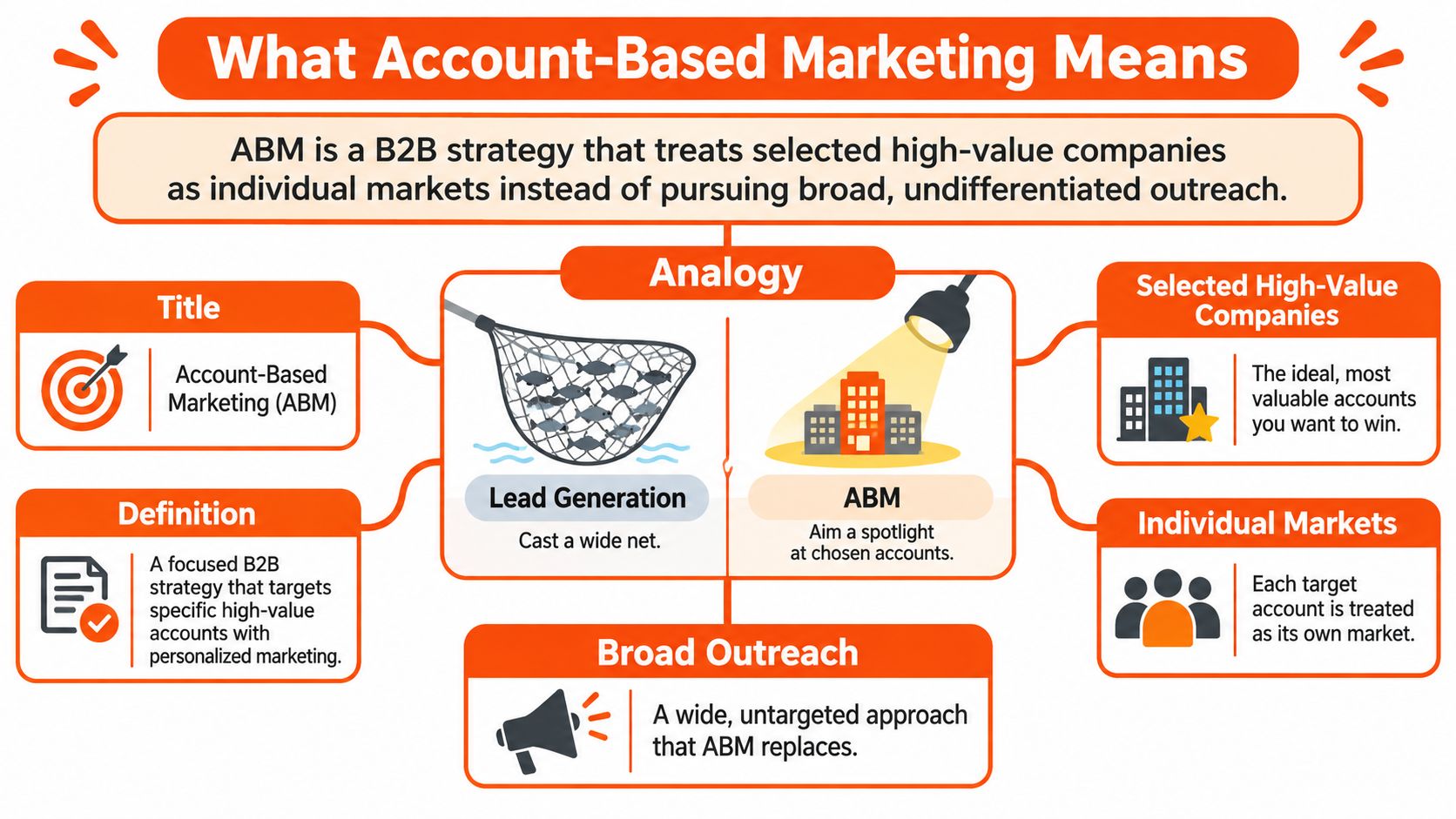
ABM replaces broad, undifferentiated outreach with deliberate account selection and coordinated attention. An account is a company you want to win or expand, not just a contact record in your CRM.
Think of conventional lead generation as casting a wide net. ABM is closer to aiming a spotlight at chosen companies, then adjusting what you illuminate for the people inside them. You're not just narrowing the audience for the same campaign.
The historical distinction matters: according to Wikipedia's account-based marketing overview, Bev Burgess at the Information Technology Services Marketing Association coined the term in 2003, building on earlier key-account management and industrial marketing. The important shift was from planning around individual leads to planning around an account and its buying committee.
Where the approach makes sense
ABM is particularly relevant when potential customers are relatively scarce, contracts are valuable, purchases take time and several people influence the decision. Technology services, consulting, enterprise software and professional services fit that pattern.
The foundation is straightforward:
- Choose for fit: Define the companies whose problems your firm can solve profitably.
- Build relevance: Address the priorities of the people who influence the purchase.
- Measure commercial progress: Watch account engagement, opportunities, pipeline and revenue rather than reach alone.
For a practical companion to those principles, Salesmotion's account based marketing playbook offers an account-focused planning resource.
So, what is account based marketing in language you can repeat to a colleague?
ABM means organizing the team around companies worth winning, not just contacts worth collecting.
How ABM Differs From Lead-Based Marketing
| Dimension | Lead-based marketing | Account-based marketing |
|---|---|---|
| Unit of planning | Individual lead | Named account and its buying group |
| Success metric | Lead volume and form fills | Pipeline, opportunities and win rate |
| Content approach | Broad offers for many contacts | Messages tailored to account priorities |
| Sales role | Sales follows up on leads as they arrive | Sales and marketing own target accounts together |
| Typical volume | Broad contact pools | A finite list of high-value accounts |
| Best fit | Short, simple purchases with many buyers | Long, multi-stakeholder purchases with high contract values |
The planning unit changes the campaign brief. Instead of asking which offer will attract contacts, the team asks which companies deserve attention and what would make the offer relevant to them.
Measurement and content change together. A popular download may produce leads without advancing a target account; a narrowly relevant technical briefing may help a buying group resolve an objection. Lead-based programs still need sound qualification, and Data Hunters Agency's guidance on how to turn form fills into sales-ready leads addresses that separate challenge.
A different working relationship
Sales participates before launch, not just after someone submits a form. Marketing and sales agree on account priorities, the people to involve and the next useful interaction.
A 2024 study summarized by Demandbase found that 71% of B2B organizations were using, testing or interested in ABM; among organizations using it for at least a year, 60% attributed revenue increases to the strategy. These are adoption and reported outcome figures, not a promise of performance.
The volume and sales-cycle rows explain the trade-off: account attention consumes time that could otherwise support broader acquisition. Many firms therefore use both models, reserving ABM for strategic opportunities while maintaining lead programs for smaller, simpler purchases.
ABM is a commercial operating model, not an advertising format. Buying company-targeted ads doesn't create it on its own.
Three Tiers of ABM from One-to-One to One-to-Many
ABM has different levels of intensity. Choose the level according to the attention your team can sustain, not the size of the list your software can hold.
Match effort to account potential
- One-to-one: Build a bespoke program for a strategic account, with custom research, executive content and dedicated account-team involvement. A consulting firm might prepare a briefing on a particular bank's technology agenda for its chief information officer. Reserve this effort for opportunities that justify the work.
- One-to-few: Group accounts with a shared sector, challenge or business context. A regional-banking playbook can support a cohort, while sales adapts follow-up to each bank's priorities. The efficiency comes from shared relevance, not identical messages.
- One-to-many: Use repeatable campaigns filtered by company characteristics and buying signals. A software firm might adapt ads and emails for finance and operations leaders at professional-services companies. Personalization is lighter, so targeting discipline matters more.
Deeper personalization costs more time per account. Set an account cap for each tier and specify what merits additional attention, such as relevant stakeholders beginning an active evaluation.
Moving an account down a tier is equally important when its project stalls or its commercial fit weakens. Otherwise, the team keeps investing because it has already done the research.
Every tier still needs a bounded account list, buying-role visibility and shared ownership. Scale changes the delivery method, not the underlying discipline.
The Core Components of an ABM Program
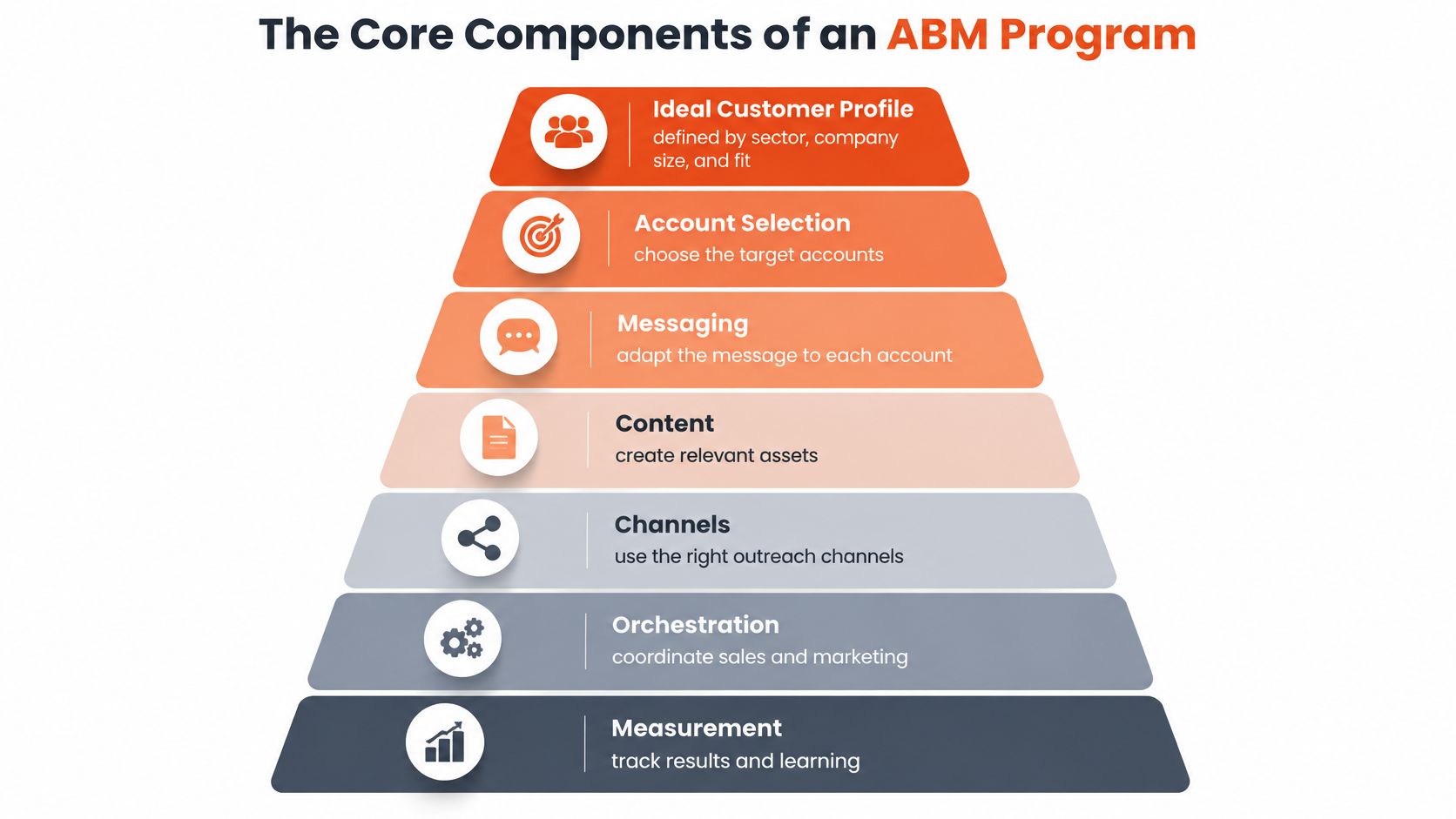
An ABM program works as a hierarchy: customer fit guides selection, selection guides engagement, and measurement tests whether the effort was worthwhile. Consider a consulting firm selling modernization services to banks.
Establish who deserves attention
- Ideal customer profile: Define sector, company size, budget suitability and the problems you solve best. The consultancy might prioritize banks with complex legacy systems and an identifiable modernization mandate. The mistake is describing an attractive company without identifying a problem you can address.
- Target account list: Score named banks for fit and commercial potential, then select a manageable working list. Don't include every recognizable institution because its logo would look impressive.
- Buying-group map: Record the economic buyer, technical reviewers, finance, operations and end users. For a bank, that might mean distinguishing the technology sponsor from the risk reviewer. The common mistake is assuming your existing contact represents everyone's requirements.
Design engagement and feedback
- Account-specific content: Connect expertise to the bank's priorities, with executive perspectives, sector analysis and implementation guidance. A risk briefing should answer different questions from a technology roadmap. Changing the company name on a generic document isn't meaningful personalization.
- Channels: Choose LinkedIn, email, events and selected advertising according to the role and context. A partner's LinkedIn analysis might open a discussion that continues through an invited briefing. Don't force every stakeholder through the same sequence.
- Intent signals: Review relevant content engagement, profile activity, hiring and company news for possible evidence of need. A bank recruiting transformation leaders may warrant investigation, but it doesn't establish an approved project.
- Measurement: Connect engagement to account progression and commercial outcomes. The consultancy should be able to distinguish attention from an evaluation that sales can advance. Reporting impressions without account context hides that distinction.
The components should reinforce one another. If reporting can't show which target banks are progressing, adding another channel won't fix the underlying problem.
Who Owns What in Sales and Marketing Alignment
| Role | Core responsibility | Key metric |
|---|---|---|
| Marketing director | Defines the ideal customer profile, budget and account content plan | Pipeline influenced by target accounts |
| Sales director or business development lead | Owns the named account plan and outreach | Meetings and opportunities per account |
| Demand generation lead | Runs intent signals, campaigns and account reporting | Account engagement and buying-group coverage |
| Executive or trusted partner profile | Shares sector expertise and joins relevant meetings | Replies and meetings from target accounts |
| Revenue operations or CRM administrator | Connects account records, data quality and reporting | Accuracy of account and contact data |
Assign a named salesperson and marketer to each target account. Give them a regular account-planning meeting to interpret signals, resolve gaps and agree who acts next; a monthly planning review can sit alongside more frequent operational checks.
Shared ownership doesn't mean everyone sends messages. Sales owns the commercial conversation, marketing develops relevant engagement, and revenue operations keeps the evidence connected. A practical B2B marketing and sales alignment framework helps make those handoffs explicit.
The single-executive trap
Gartner's 2025 ABM measurement guidance emphasizes account and pipeline metrics, buying-group behaviors and attribution, rather than traditional lead metrics. That changes what the team should discuss in an account review.
Suppose a managing director repeatedly engages with a consulting partner's posts. Marketing sees enthusiasm; sales assumes access to a decision-maker. Yet finance hasn't examined the business case, operations hasn't considered implementation and the technical team hasn't reviewed feasibility.
The missing information isn't another engagement score. It's which necessary roles remain uninvolved.
Strong interest from a senior contact is an opening, not proof of organizational agreement.
The account plan should record known stakeholders, their concerns, observed engagement and unresolved questions. It should also distinguish a contact who enjoys the content from a sponsor willing to involve colleagues.
As a working rule, prefer moderate, coordinated engagement across relevant roles to repeated activity from a single profile. Test that judgment against opportunity progression rather than treating it as an automatic qualification formula.
How an ABM Program Runs From Account Selection to Pipeline
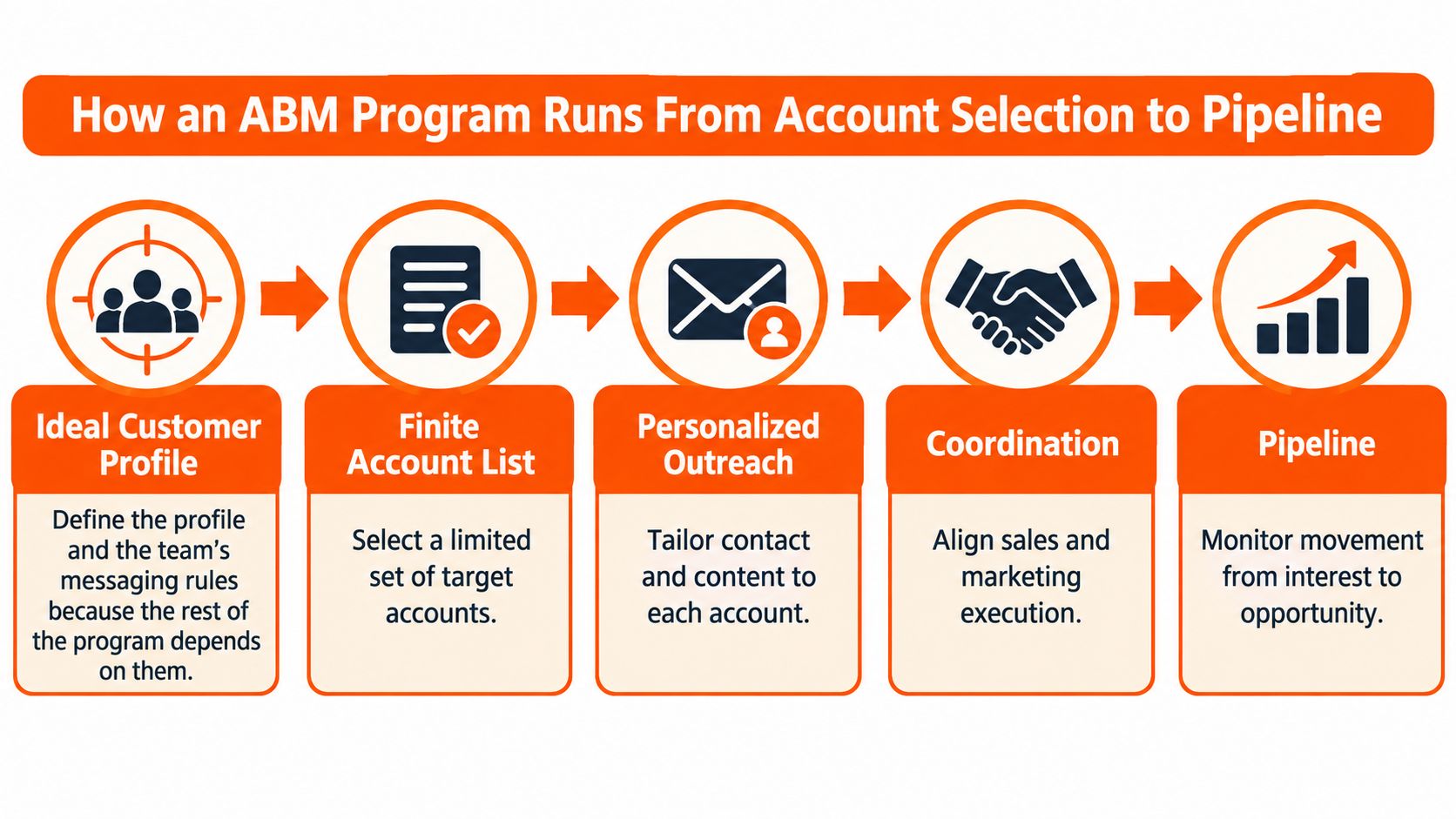
The 6sense ABM benchmark identifies stronger programs with sales alignment around selected account cohorts and attention to buying groups throughout the journey. Translate that principle into a workflow your team can run.
Prepare the account plan
Define fit and messaging rules. Write down the problems you solve, the companies you serve and the claims your team can substantiate. Without these boundaries, sellers prioritize familiar names and marketers create disconnected messages.
Select and score accounts. Use fit and commercial potential to determine inclusion, with clear exclusion criteria. Remove weak candidates rather than keeping a list that exceeds the team's capacity to personalize.
Map the buying group. Identify who benefits, who approves expenditure, who evaluates risk and who must implement the change. Don't confuse a senior job title with a verified purchasing role.
Set an account-qualification rule. Require corroborating engagement from relevant roles and evidence of a plausible need. Explicit requests for help deserve prompt handling, but an executive's clicks alone shouldn't trigger an opportunity declaration.
Coordinate action and learning
Assign the owners. Record the salesperson, marketing counterpart and next action in the CRM account record. The common failure is shared responsibility without a named person accountable for follow-through.
Launch connected engagement. Use trusted profiles and useful content, then make outreach relevant to the account's demonstrated interests. The CleanMyList guide to sales prospecting provides useful prospecting context; the ABM distinction is connecting that work to an account plan rather than an isolated contact list.
Review signals regularly. Use a weekly review to advance, pause or investigate accounts, keeping source, role and timing attached to each observation. This guide to B2B intent data helps distinguish signals worth examining from activity that lacks context.
Evaluate commercial progression. Apply the measurement checklist below instead of declaring success from campaign engagement. Don't keep moving qualification thresholds after launch to make the program look productive.
By the end of an initial pilot, aim for clearer stakeholder coverage, relevant conversations and an auditable account history. Those are useful operating goals, not guaranteed outcomes or a reason to rush a purchase that isn't ready.
Illustrative ABM Scenarios in Consulting and Software
These are illustrative scenarios, not customer results. They show how teams can make different decisions from the same basic operating model.
The collaboration involved spans content planning, account review and commercial conversations.

Illustrative HR consultancy scenario
An HR consultancy selects mid-sized Spanish companies facing workforce change. Its partners publish talent-strategy content, and the team notices relevant engagement from HR, finance and an employee-representation contact at a target company.
Rather than sending unrelated pitches, the account owner offers a discussion about implementation and stakeholder concerns. The team tracks meetings by account and learns whether cross-functional interest produces more substantive conversations than HR interest alone.
Illustrative IT consulting scenario
An IT consultancy targets banks with modernization needs. It prepares separate material for technology leaders and risk reviewers, then reviews account activity with sales each week.
When technical engagement appears without risk participation, the seller asks the existing contact how risk assessment will work. The team measures stakeholder involvement and opportunity progression, learning where evaluations stall rather than increasing outreach.
For another explanation of ABM, the following video provides a complementary format.
Illustrative software scenario
A software company targets organizations where marketing would use the product but finance would approve the expenditure. Its team treats a finance leader's substantive webinar participation as a reason to investigate budget questions, not as an automatic sales qualification.
It compares subsequent conversations with those generated by generic clicks. The lesson is about signal quality and role relevance, not a universal rule that webinar attendance predicts purchase.
Each scenario uses a selected account universe, an explicit stakeholder view and a coordinated commercial decision.
Measuring ABM Results and Reading the Benchmarks
In N.Rich's survey of 107 B2B go-to-market leaders, organizations running ABM associated it with increased pipeline (77%) and improved engagement at target accounts (69%), while only 26% described their ABM program as successful. These are reported associations, not randomized causal estimates, so they aren't guaranteed uplifts or a forecast for your firm.
The practical mechanism is prioritization. Your team concentrates scarce outbound capacity on suitable accounts showing relevant activity and spends less time on companies that don't fit or aren't ready.
Build a pilot scorecard before launch
Use a bounded pilot with success criteria agreed in advance. The scorecard should make it possible to distinguish better execution from a change in account mix.
- Define the account universe: Record included accounts, selection reasons and assigned treatment. Keep a comparable non-ABM group where practical, accounting for differences in size, sector and existing relationships.
- Establish the baseline: Record historical meetings, opportunity conversion, pipeline value, win rate and sales-cycle length. Use consistent stage definitions so the comparison means something.
- Preserve signal context: Store the stakeholder role, activity, timing and resulting action. Aggregate clicks without context won't explain why sales contacted the account.
- Track progression: Follow accounts from selection through relevant conversations and opportunities. Record losses, pauses and disqualification reasons, not just advances.
- Check effort: Include content preparation, executive participation, sales follow-up and data administration. Pipeline without an effort denominator can conceal an expensive program.
A practical guide to measuring account-based marketing can help translate those requirements into an account-level reporting routine.
Separate sourced and influenced pipeline
Sourced pipeline means the program originated an opportunity under your agreed attribution rule. Influenced pipeline means the program contributed to an opportunity that may already have existed or originated elsewhere.
Don't add the categories together if the same opportunity appears in both. Set the rules before launch, including what qualifies as meaningful influence and the period in which an interaction counts.
Account-level attribution matters because several stakeholders may interact before a single opportunity advances. Give the team visibility into that sequence without pretending every touch caused the eventual sale.
Measurement discipline: Report what happened, what you can reasonably attribute and what remains uncertain.
A successful program needs sound strategy, usable records, coordinated follow-up and honest evaluation. Personalizing messages can't compensate for selecting the wrong accounts or ignoring what happens after a meeting.
Confirm Your Fit Before Launching an ABM Pilot
ABM fits when your deals justify account-level effort, your potential market is bounded, purchases involve several roles and sales can work named accounts. You also need capacity to review evidence regularly. If those conditions don't hold, improve the existing lead program first.
6sense's guide to changing B2B buyer research describes substantial research before vendor engagement, much of it anonymous. Don't mistake visible activity for the buyer's entire journey.
Decide when a signal warrants contact
- Separate data types: Anonymous company-level activity doesn't identify a particular person or establish permission to contact them.
- Corroborate relevance: Look for multiple meaningful signals from appropriate roles; don't equate a content interaction with buying intent.
- Document the basis: Record purpose and lawful basis for personal-data use, with appropriate legal review for the activity and jurisdiction.
- Respect the recipient: Provide a clear opt-out and have a person review outreach before it goes out.
For European firms, including those in Spain, favor first-party engagement and transparent professional-context communication over indiscriminate tracking. Intrusive outreach can undermine the credibility of the executive whose profile carries it.
At Ploot, we define the client's ICP and each team member's writing approach on day one. We don't do mass prospecting: we contact low volumes, only people who have already interacted with the client, its company or its sector. Users remain responsible for reviewing and approving all AI-generated content before publication.
Choose a short account list and explicit pilot criteria, or retain your lead program until the operational fit is there.
Ploot helps your team build a relevant LinkedIn audience, detect buying intent and contact interested prospects from trusted team profiles to book qualified sales meetings. Visit Ploot to discuss a three-month pilot with agreed success criteria and assess how that workflow could support your target-account strategy.