

You've written the email carefully. You've explained the proposal, answered the obvious question, and made the next step clear. Then you reach the closing line and type “I look forward to hearing from you” for the third time that day. The phrase is correct, but it may feel too repetitive or too vague when the true purpose is to express enthusiasm, signal preparation, show account progress, or invite a specific action.
The best another way of saying looking forward depends on what you want the reader to understand. The eight alternatives below are organized around practical B2B situations, from pipeline planning to conversion momentum. Each entry explains the tone, where the phrase fits, how to use it in a closing line, what it may imply, and how to avoid overpromising. For broader guidance on professional LinkedIn communication, see these LinkedIn post best practices.
Table of Contents
- 1. Anticipating Pipeline Growth
- 2. Excited About Upcoming Opportunities
- 3. Building Momentum Toward Target Accounts
- 4. Eager to Engage With Interested Prospects
- 5. Positioned to Capitalize on Market Momentum
- 6. Primed to Connect With Decision-Makers
- 7. Ready to Deliver Value at Scale
- 8. Energized by Upcoming Pipeline Conversions
- 8 Sales-Focused Alternatives to Looking Forward
- Match the Phrase to the Moment
1. Anticipating Pipeline Growth
“Anticipating pipeline growth” sounds deliberate, strategic, and commercially focused. It doesn't suggest that something may happen in the future. It implies that a team is preparing for likely opportunities and thinking about how those opportunities will develop.
That makes it useful for marketing directors, demand generation leaders, and sales teams discussing intent data, account activity, or upcoming campaigns. For example, a marketing director might write, “We're anticipating stronger pipeline development as the new account program reaches more qualified buyers.” A B2B software company could use similar wording when preparing sales sequences before prospects actively request information.
The phrase works best when the sender can explain what preparation supports the expectation. Without that context, “anticipating” can sound like an unsupported forecast. Use it alongside a defined audience, campaign, account segment, or planning action rather than presenting growth as guaranteed.
Practical rule: Use “anticipating” when you want to communicate preparation, not certainty.
A closing line could read:
- “We're anticipating meaningful pipeline growth from the accounts identified in this review.”
- “I'm looking forward to discussing how we can prepare for the next group of opportunities.”
- “We're anticipating the next stage of account activity and will share the proposed sales sequence on Friday.”
For a more structured approach, connect the wording to a pipeline generation plan. Teams can also explore AI-driven revenue intelligence when they need a clearer view of signals, accounts, and sales priorities.
The limitation is tone. This phrase may feel too analytical for a warm client email or an informal internal message. It belongs in planning documents, executive updates, campaign briefs, and conversations where pipeline quality matters more than emotional enthusiasm.

2. Excited About Upcoming Opportunities
“Excited about upcoming opportunities” adds energy without abandoning professional clarity. It works when the sender wants to show genuine enthusiasm about qualified leads, a new campaign, a promising account group, or a partnership discussion.
A CMO might write, “We're excited about the upcoming opportunities identified through our account research.” A marketing director speaking to an executive team could say, “I'm excited about the opportunities this intent-led strategy may create.” The wording is positive, but it doesn't claim that those opportunities will become revenue.
That distinction matters. Excitement describes the team's attitude. It doesn't prove that a campaign will perform, that a prospect will buy, or that a meeting will convert. Keep the phrase credible by naming the reason for the enthusiasm, such as a new segment, a qualified conversation, or a specific campaign milestone.
Try these closing lines:
- “We're excited about the upcoming opportunities and will review the priority accounts together.”
- “I'm excited about the next phase of the campaign and would value your perspective.”
- “We're excited to explore whether these qualified opportunities fit your growth priorities.”
When the warmer tone helps
This alternative suits internal updates, partner communications, client-facing proposals, and stakeholder presentations. It can make a message feel more human than “we anticipate,” especially when people have contributed to the work.
The trade-off is that “excited” can sound premature if the evidence is still limited. Don't use it to disguise uncertainty or pressure a recipient into agreeing. Pair enthusiasm with the next practical action, such as reviewing the accounts, confirming campaign messaging, or scheduling a discussion.
A useful pattern is emotion plus evidence plus action. For example: “We're excited about the qualified accounts identified in the review and would like to discuss the best follow-up sequence.” The sentence communicates interest while keeping the reader focused on a real next step.
3. Building Momentum Toward Target Accounts
“Building momentum toward target accounts” emphasizes gradual progress. It fits B2B sales environments where several stakeholders influence a decision and where repeated, coordinated activity matters more than one immediate response.
A demand generation leader might use it in an account-based marketing update: “We're building momentum toward the target accounts identified for this quarter.” A consulting firm could write, “Our partner-led content is building momentum across several strategic accounts.” The phrase acknowledges that engagement may develop through multiple interactions.
Unlike “excited about,” this wording is less emotional. Unlike “anticipating pipeline growth,” it focuses less on the eventual commercial result and more on movement through the account journey. That makes it useful when the team is tracking engagement, content interaction, profile activity, or conversations across several roles.
Use concrete language around the phrase:
- “We're building momentum toward the target accounts, with several stakeholders now engaging with the program.”
- “I'm looking forward to reviewing how we can build momentum across the priority account list.”
- “Our next step is to build momentum with the accounts that have shown consistent interest.”
The limitation is that momentum can become vague if nobody defines what progress means. A growing list of impressions isn't automatically account progress. Establish whether momentum means more relevant stakeholders engaged, a productive conversation started, a meeting accepted, or a buying question raised.
For teams coordinating marketing and sales activity, marketing and sales alignment can provide a useful operational context. Align the message, ownership, and follow-up timing before describing an account as active or progressing.
“Momentum should describe observable movement, not optimism about movement.”
This phrase works particularly well in account reviews, sales enablement notes, and updates to senior leaders. It sounds patient and strategic, which is valuable when a long buying process requires consistent attention rather than a rushed close.
4. Eager to Engage With Interested Prospects
“Eager to engage with interested prospects” communicates readiness and enthusiasm, but the important word is interested. It positions the next conversation as a response to demonstrated attention rather than an unsolicited interruption.
A marketing team might identify professionals who viewed a relevant case study or interacted with solution content. A sales representative could then write, “We're eager to engage with prospects who have shown interest in this topic.” A consulting firm might use the phrase when discussing outreach to people already researching a service category.
This alternative is warmer than “ready to contact prospects,” but it should still be handled carefully. A signal of interest doesn't necessarily mean that a prospect wants a sales call. Use language that acknowledges relevance without pretending to know the buyer's intentions.
Useful examples include:
- “We're eager to engage with interested prospects and understand what they're evaluating.”
- “I'd welcome the opportunity to speak with the people who've shown interest in this solution.”
- “We're ready to continue the conversation with prospects whose needs align with our expertise.”
Make the outreach permission-aware
The phrase becomes more credible when the message explains what generated the interest and gives the recipient room to respond. “You viewed our case study, so book a call now” may feel intrusive. “I noticed your interest in the topic and thought the operational example might be useful” is more measured.
A sales engagement platform can help teams organize signals, contact ownership, and follow-up workflows. See this overview of a sales engagement platform for context on how those activities can fit together.
The trade-off is that “eager” may sound too forceful in a formal procurement process or a first message to a senior executive. In those cases, use “prepared to discuss,” “available to explore,” or “happy to continue the conversation.” Reserve “eager” for situations where the sender can demonstrate relevance and the prospect has already opened a meaningful door.

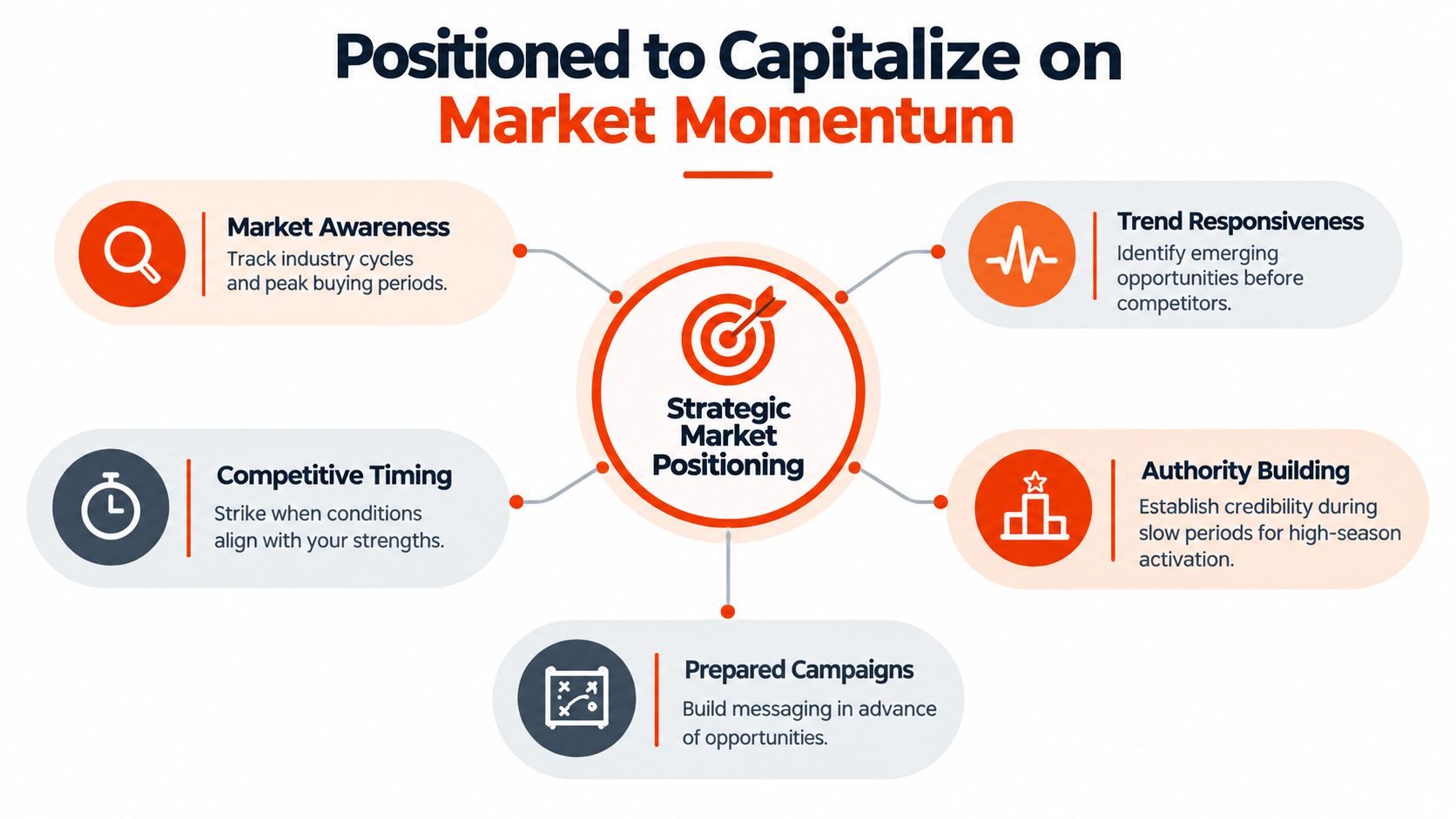
5. Positioned to Capitalize on Market Momentum
“Positioned to capitalize on market momentum” is a strategic alternative for messages about preparation, timing, and competitive readiness. It tells the reader that the team has built capabilities or created conditions that may help it respond when demand develops.
A B2B software company might say, “We're positioned to capitalize on demand as more buyers evaluate workflow technology.” A consulting firm could write, “Our senior team is positioned to support clients during the next phase of industry change.” A talent acquisition company might use the phrase when preparing thought leadership and outreach before a busy hiring period.
This language is strongest in executive communication, strategic planning, campaign briefs, and board-level updates. It sounds more measured than “we're excited,” and more active than “we're looking forward to what happens next.”
Try:
- “We're positioned to capitalize on market momentum, with the campaign and messaging ready for review.”
- “I'm looking forward to discussing how our preparation supports the current market opportunity.”
- “The team is positioned to respond quickly as priority accounts begin evaluating solutions.”
The phrase has a clear limitation. Positioning isn't the same as performance. A prepared campaign, credible profile, or researched account list may improve readiness, but it doesn't guarantee attention, meetings, or revenue. Make the sentence concrete by naming the preparation behind the claim.
Research industry buying cycles, update messaging before the relevant period, and monitor competitor activity without turning the closing line into a prediction. “Positioned to capitalize” should describe capability and timing, not promise an outcome that the sender can't support.
6. Primed to Connect With Decision-Makers
“Primed to connect with decision-makers” signals targeted readiness. It suggests that the team understands who influences the purchase and has prepared the right message for each stakeholder.
That distinction is important in B2B software and consulting. A buying group may include finance, technology, operations, procurement, and business process leaders. A single generic closing line can miss the practical concern of each role. “Primed to connect” encourages the sender to think about relevance before contact.
Examples include:
- “We're primed to connect with the decision-makers responsible for this transformation.”
- “Our team is prepared to speak with finance and technology stakeholders about their separate priorities.”
- “I'm looking forward to connecting with the decision-makers who are evaluating this approach.”
The phrase works well in campaign plans, sales handoff notes, and internal updates. It can also fit a client-facing email when the recipient has already agreed to introduce relevant colleagues.
Keep the wording grounded
“Primed” has more energy than “prepared,” but it can sound like marketing jargon if the team hasn't done the groundwork. Before using it, map the buying committee, identify the role each profile should address, and prepare role-specific questions. Coordination matters too. Multiple people contacting the same account with disconnected messages will weaken the sense of readiness.
For a more conservative audience, replace it with “prepared to connect with” or “ready to speak with.” Those versions are less punchy and often safer in formal proposals or regulated sectors.
The market-positioning infographic below illustrates the broader principle. Strong language should reflect a real plan for reaching relevant stakeholders, not merely confidence in the campaign.
7. Ready to Deliver Value at Scale
“Ready to deliver value at scale” shifts attention from anticipation to capability. It works when a team wants to show that its processes, people, and systems can support more than isolated wins.
A demand generation team might write, “We're ready to deliver value at scale through a repeatable intent-led outreach process.” A marketing department moving beyond one-off campaigns could say, “The team is ready to deliver value at scale across priority segments.” A consulting firm might use the phrase when explaining how partner-led business development can support several markets.
This wording appeals to pragmatic stakeholders because it focuses on what the team can deliver. Still, it carries a high burden of proof. “At scale” implies repeatability, capacity, consistency, and measurement. Don't use it merely because a pilot worked or because a new tool has been activated.
Use a closing line such as:
- “We're ready to deliver value at scale and would welcome a discussion about the operating model.”
- “The system is prepared to support more accounts while preserving role-specific messaging.”
- “I'm looking forward to reviewing how the process can deliver value across the agreed priority segments.”
Check the operating reality
Before making the claim, confirm that ownership, content production, data handling, follow-up, and reporting are all defined. Then explain how the team will measure delivery against the value proposition. If the organization is still testing the process, use “building toward repeatable delivery” instead.
The tone is confident and results-oriented, but it may feel too strong for a tentative conversation. Use it with executives, operational stakeholders, and teams evaluating whether a program can support broader adoption. Avoid pairing it with unsupported promises about revenue, response rates, or conversion performance.

8. Energized by Upcoming Pipeline Conversions
“Energized by upcoming pipeline conversions” focuses on the emotional lift created by visible commercial progress. It fits internal sales and marketing communication when qualified opportunities are moving from engagement toward a decision.
A sales team could write, “We're energized by the qualified opportunities now moving through the pipeline.” A marketing director might say, “I'm encouraged by the conversations generated through partner-led outreach and energized by the next conversion stage.” A consulting firm could use the phrase when discussing engaged prospects that may become signed projects.
The wording is more celebratory than “building momentum.” It recognizes that the value of business development lies in turning relevant conversations into customer relationships. Yet upcoming doesn't mean certain. A pipeline stage is not a closed deal, and an enthusiastic update shouldn't erase the need for qualification.
Consider these examples:
- “We're energized by the upcoming conversion opportunities and will review the next actions by account.”
- “The team is encouraged by the qualified meetings and focused on helping each prospect make an informed decision.”
- “I'm looking forward to discussing what these active opportunities need to progress.”
Track the complete journey from initial engagement to meeting, opportunity, and close. Share early wins carefully, but don't turn one promising conversation into a case study or a forecast. The phrase belongs mainly in internal updates, leadership communications, and team meetings. For a formal client email, “encouraged by the progress” may sound more restrained.
The best use combines energy with accountability. Name the accounts, owners, decision stage, and next action when appropriate. That keeps the closing line motivating without making an outcome claim the evidence can't support.
8 Sales-Focused Alternatives to Looking Forward
| Phrase | Implementation Complexity 🔄 | Resource Requirements ⚡ | Expected Outcomes 📊 / ⭐ | Ideal Use Cases 💡 | Key Advantages ⭐ |
|---|---|---|---|---|---|
| Anticipating Pipeline Growth | 🔄 Moderate, forecasting + intent infra | ⚡ Medium–High, analytics, platforms, sales alignment | 📊 More predictable pipeline & better forecasting (⭐⭐⭐⭐) | Demand generation for long B2B sales cycles | Proactive positioning; outcome-focused |
| Excited About Upcoming Opportunities | 🔄 Low, messaging and stakeholder comms | ⚡ Low–Medium, supporting metrics and early wins | 📊 Increased morale and stakeholder buy-in (⭐⭐⭐) | Communicating qualified leads internally or to partners | Motivates teams; fosters optimism and buy-in |
| Building Momentum Toward Target Accounts | 🔄 High, ABM sequencing and multi-touch | ⚡ High, account lists, coordination, tracking tools | 📊 Progressive account movement; higher-quality pipeline (⭐⭐⭐⭐) | Account-based marketing and enterprise sales | Strategic targeting; prioritizes high-value accounts |
| Eager to Engage With Interested Prospects | 🔄 Moderate, intent detection + timely outreach | ⚡ Medium, intent tech, personalized outreach | 📊 Higher conversion from warm prospects (⭐⭐⭐⭐) | Intent-driven outreach and consultative selling | Permission-based engagement; improved buyer experience |
| Positioned to Capitalize on Market Momentum | 🔄 Moderate–High, market monitoring + readiness | ⚡ Medium–High, market research, content prep, timing | 📊 Competitive timing wins & strategic advantage (⭐⭐⭐⭐) | Seasonal plays, trend-driven campaigns, leadership positioning | Market-aware readiness; justifies investment |
| Primed to Connect With Decision-Makers | 🔄 High, buyer mapping and coordinated outreach | ⚡ High, multiple profiles, role-specific messaging | 📊 Better access to budget holders; higher close potential (⭐⭐⭐⭐) | Targeting buying committees and multi-stakeholder deals | Focuses on true decision-makers; sophisticated selling |
| Ready to Deliver Value at Scale | 🔄 High, systems, processes, automation | ⚡ High, automation, tracking, staffing | 📊 Scalable revenue generation and ROI (⭐⭐⭐⭐) | Scaling pilots into systematic pipeline operations | Outcome- and ROI-oriented; builds execution confidence |
| Energized by Upcoming Pipeline Conversions | 🔄 Low–Moderate, tracking and celebration rituals | ⚡ Medium, analytics, internal comms systems | 📊 Increased conversion focus and team momentum (⭐⭐⭐) | Driving alignment during conversion stages; morale-building | Celebrates progress; strengthens accountability |
Match the Phrase to the Moment
A strong alternative to “looking forward” doesn't merely make an email sound different. It tells the recipient what kind of future the sender has in mind. Use anticipation for planning, especially when the message concerns pipeline development, account preparation, or expected activity. Use excitement for positive updates when a team has a credible reason to feel enthusiastic about an opportunity.
Choose momentum for long sales cycles where progress develops through repeated interactions across an account. Use eagerness for warm outreach when a prospect has already demonstrated relevant interest, but avoid implying that interest automatically equals purchase intent. Choose positioning for market readiness when the message is about preparation, timing, and the ability to respond to a changing environment.
Use priming for decision-maker contact when the team has mapped stakeholders and prepared role-specific communication. Choose readiness for scalable delivery when the organization can support repeatable execution, clear ownership, and meaningful measurement. Use energy for conversion progress when qualified opportunities are moving forward and the audience needs a focused, motivating update.
The grammar also matters. In formal business correspondence, “look forward to” is a fixed prepositional construction and should be followed by a noun phrase or an -ing form, such as “I look forward to hearing from you.” Cambridge's grammar guidance describes its common use at the end of formal letters and emails. If you choose a replacement, preserve the same grammatical discipline.
A quick review can prevent most closing-line problems:
- Audience: Does the tone fit a prospect, client, colleague, executive, or board?
- Meaning: Does the phrase express planning, enthusiasm, progress, readiness, or conversion?
- Support: Are you promising only what the sender can reasonably support?
- Action: Does the line make the next step clear?
- Consistency: Does the closing match the substance and tone of the email?
The phrase has a longer history than its modern business use may suggest. An Oxford English Dictionary-based account traces “look forward” to a recorded use in 1546, with a Shakespeare-era example in Measure for Measure, first performed in 1604. Its later shift toward an optimistic, future-oriented sense helps explain why business writers use it as a polite closing rather than a literal directional statement, as described in this history of “look forward”.
For B2B teams, the most useful replacement is the one that reflects the actual commercial intent. If the message concerns qualified meetings rather than generic reach, language around interested accounts, decision-makers, and conversion progress is more accurate. Ploot is one relevant example of a platform whose language should focus on intent-led, qualified-meeting outcomes instead of impressions alone.
Whether you write “I look forward to hearing from you,” “we're prepared to continue the conversation,” or “we're building momentum with the account,” the standard is the same. Choose a phrase that sounds natural, matches the situation, and gives the reader a clear reason to respond.
Ploot helps B2B teams build the LinkedIn audience of partners, directors, and senior managers, detect buying intent, and contact interested prospects to book qualified sales meetings. Visit Ploot to see how intent-led outreach can make your closing language more specific, relevant, and connected to pipeline.